We are gathering interest in the new programs while they are being prepared. You can explore the details without buying or reserving a place.
You want more than a walk you managed to get through.
You would like to enjoy your dog's company without always watching for the thing that might happen next.
Perhaps you already know which side streets are quiet. You can spot another dog half a block away. You've become very good at getting home.
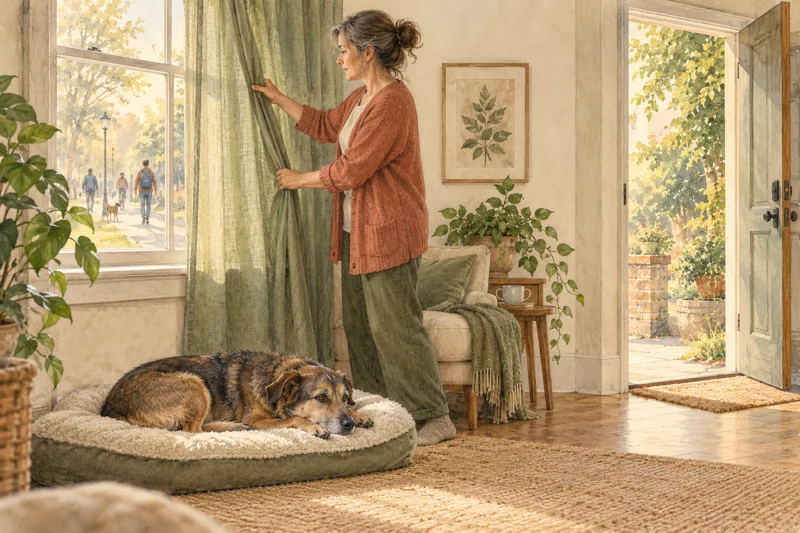
Or the hard part happens afterward. You've walked, played, offered another activity, and your dog is still listening at the window while you wonder what else to try.
Advice is easy to find. Knowing which piece belongs to this dog, on this day, is harder.
That is what I want to help you learn.
To notice when curiosity is becoming difficult to leave. To recognize when adding an activity helps and when there has been enough. To have a next step you understand, instead of reaching for another cue and hoping it works this time.
Your dog may still have difficult days. You can become better equipped to meet them, without treating every hard moment as a verdict on your relationship.
Begin with the part you can see.
Think of a recent moment when something became difficult. Set aside the label for a minute: stubborn, overexcited, reactive, anxious.
What actually happened just before it?
Perhaps your dog stopped sniffing. Perhaps you reached a narrow section of sidewalk. Perhaps the visitor had been there for a while, or another noise arrived before your dog had settled from the first.
Choose one detail you remember. Then ask what could make the next version of that situation easier: a wider route, a quieter time, less activity, or a chance to finish sooner.
You do not need to recreate the difficult moment to find out. This is reflection, not a test for your dog. If you can't remember the earlier part, that gives you something useful to watch for next time, at a safe distance and without increasing the challenge.
The first gain can be a clearer decision, before there is a dramatic change in behavior.
That is a starting point you can carry into ordinary life. What changed? What can I make easier? What does my dog do next?
Start where learning begins.
Start where learning begins.
The same dog can find one setting manageable and another overwhelming. Looking only at whether a cue was followed leaves out much of that story.
My approach begins with the whole situation: the dog, the surroundings, what has already happened, and what you are asking now. We consider activity and recovery, space and choice, and how your own timing and handling may influence what happens next.
The aim is practical. You learn to notice earlier, respond more thoughtfully, and recognize when to stop adding difficulty.
A short scent search can offer a quiet place to practice those skills. A change in distance can make an outing more manageable. Sometimes the useful next step is a familiar place to rest, rather than another task.
There is no single answer for every dog. You are learning how to work out a suitable answer for the one beside you.
Help that begins with an invitation.
Permission-based bioenergy balancing is part of my work, and a focus of the separate Whole Dog recovery series.
In that work, I offer contact rather than reaching for the dog. A dog can approach, move away, or decline. I pay attention to the whole response and whether the dog continues to choose the interaction. Quietness alone does not tell us that a dog is comfortable.
For you, the learning is in those choices: recognizing an invitation, noticing when contact is no longer welcome, and allowing a pause without feeling you need to do more.
You learn to watch participation in context: what your dog was doing before the invitation, how they respond, and whether they keep choosing the contact. That can help you decide whether to continue, pause, or leave more room.
What I want you to take into your next ordinary day.
A better eye for the moment before the reaction. You learn to connect changes in your dog's behavior with the setting and what happened before, rather than assigning one meaning to a single signal.
More choices than holding tighter or trying harder. Distance, duration, the level of distraction, and the demands of an activity become things you can adjust thoughtfully.
A way to judge whether an activity suits your dog. You watch interest, choice, difficulty, and recovery. The goal is not to finish an exercise regardless of the response.
A kinder, more useful way to review a hard day. What did you notice? What helped? What would you change next time? Those questions give you something to work with.
Time together that isn't only about managing a problem. Curiosity, a shared activity, an invitation accepted or declined: ordinary moments can become part of learning about each other.
Learning with me.
I am Lorrie J. Harris, founder of Coaching Canine Companions in North Kingstown, Rhode Island. I am a Master Dog Trainer through National K-9, an AKC Approved CGC Evaluator, AKC Fit Dog Certified, and a U.S. Navy veteran.
When I teach, I want you to understand the reasoning behind a suggestion. What did we notice? Why make more room here? Why wait in this moment, and finish in another?
That understanding matters when you are back at home with your own dog. You cannot carry every instruction into every situation. You can develop a way of looking, a few useful questions, and the confidence to adjust when the situation changes.
You can begin with the free teaching already available, or explore the learning format that fits your life. The new programs are being prepared; the pages below explain their design so you know what you are expressing interest in.
The Whole DogSix live classes around a focused need.
You do not have to take Whole Dog before joining the full program.
How would you like to learn?
At home, at your own pace: Canine Sensory Connection Independent gives you four in-depth practical modules, supported by stories, observation, and reflection.
At home, with written accountability: the same Canine Sensory Connection curriculum adds defined written review from Lorrie.
In conversation with a small group: the Whole Dog offers separate live six-class series for reactivity and for recovery. They are not prerequisites for one another.
Whole Dog can be an approachable first step; Canine Sensory Connection offers the more extensive practical study. You may begin with the format that fits you—there is no requirement to purchase one before the other.
Canine Sensory Connection: understand the dog in your everyday life.
The full self-paced program combines four in-depth practical modules with a supporting library and 81 accompanying sensory encounters. You learn to prepare clear activities, guide without over-directing, support a more manageable day, and build shared practices that fit your dog.
Vela's encounters add another way to understand those daily moments: 51 include practical or observational invitations, and 30 are reflection only. They accompany the deeper teaching rather than replace it.
One encounter might help you describe what happened before a reaction without applying a label. Another asks you to notice your hands and posture, consider a resting place, or recognize when an invitation has been declined. A suitable search offers a small setting for practicing observation and timing. Not every lesson is a search, and not every evening asks you to do something.
The learning reaches beyond a single behavior problem: body language in context, permission and choice, daily demands and recovery, handling and communication, household life, adoption and change, and the relationship as a dog grows older. Later reflective stories include illness, loss, and grief; you receive advance notice and may skip them.
The benefit is a more useful way to understand what is happening and decide what to change—not another collection of labels for your dog.
Enough structure to help, without a perfect daily streak.
12 Fireside teaching letters connect the encounters. Seven Fireside Self-Checks give you places to reread, consider one real moment, and choose a manageable next step. Three written Canine Resilience Assessments give you a starting description and two later comparisons. They organize your observations; they are not clinical tests.
The accompanying encounters suggest about 10 minutes of reading, up to 15 minutes for a suitable field invitation, observation, and notes, and about 30 minutes for a Self-Check. An actual search may be only a minute or two. Reflection-only encounters deliberately leave you with nothing extra to complete.
You can simplify, rest, or miss an evening without starting over. The deeper module study follows your own pace and your dog's readiness, not a demand to complete every activity.
1. Give your dog a clear, achievable place to begin.
2. Build cooperation without directing every move.
3. Make the day more manageable before asking for more.
4. Bring a small repertoire of shared activities into ordinary life.
Four in-depth modules. Skills you can use beyond the lesson.
Four in-depth modules. Skills you can use beyond the lesson.
The practical teaching in Phase One of Canine Sensory Connection gives you more than something to read. You learn how to set up an activity, communicate clearly, recognize what needs adjusting, and bring that understanding into daily life. Supporting books and guides explain the how-to; the work is in what you and your dog learn to do together.
1. Give your dog a clear, achievable place to begin.
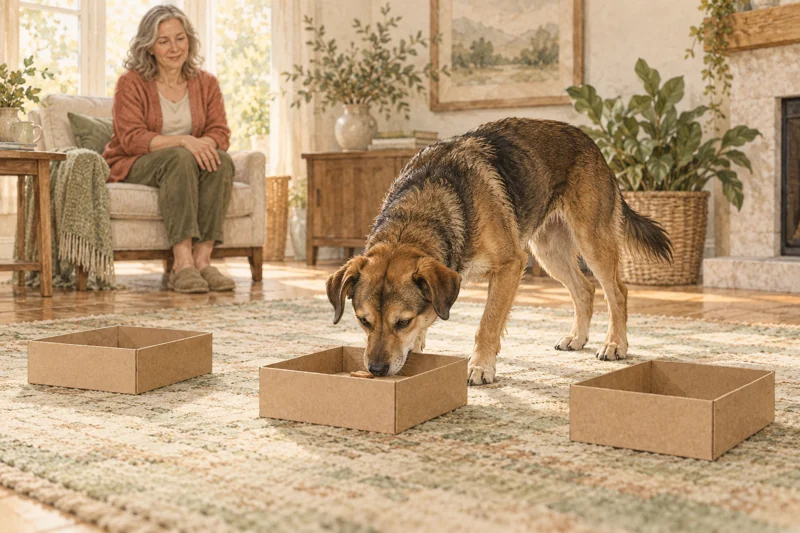
Learn to prepare a suitable search space, introduce a simple food find, and use a clear marker and reward placement. Practice saying less, giving your dog time to investigate, and noticing when your help is useful—or when it interrupts the search.
Eight foundational studies build your ability to adjust an activity without guessing. You learn to observe before, during, and afterward, change one demand at a time, and choose whether to repeat, simplify, or finish.
What that gives you: a shared activity you know how to set up, and a clearer way to decide whether it suits your dog today. You do not need specialty odors or complicated equipment to begin.
2. Build cooperation without directing every move.
A search needs a clear purpose and a comfortable ending. In five practical phases, you learn how to make both understandable: what your dog is looking for, where the reward belongs, and how the activity finishes.
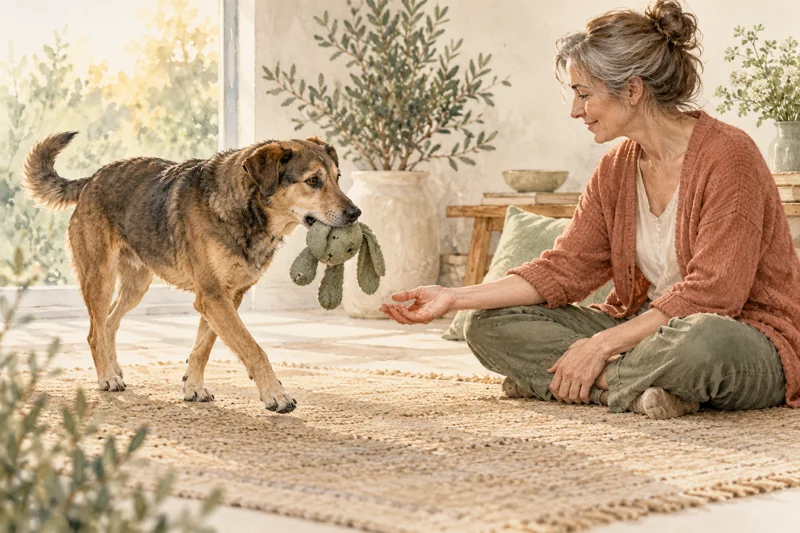
A dog may willingly carry an appropriate object and give it back, or show you the find where it is. Food searches can remain a complete route. Retrieving is not a test every dog must pass.
You practice joining suitable steps, using quiet handling, and adjusting distance, duration, or distraction one at a time. Optional trails and helper-set searches offer further possibilities when appropriate.
What that gives you: a way to cooperate with your dog while leaving room for them to solve a manageable problem—not another activity you have to talk them through from beginning to end.
3. Make the day more manageable before asking for more.
Learn to look at the life around the difficult moment: interrupted rest, repeated demands, narrow spaces, access to choices, and the outings your dog finds hard.
The teaching moves from understanding context to practical daily support: suitable foraging, protected rest, removing an avoidable demand, and planning places to turn away. You learn to record what actually happened and compare similar situations rather than judging whether your dog was “good.”
Controlled work near a difficulty is a further option only when suitable, with preparation and an individual plan. It is not compulsory, and completing a checklist does not make a dog ready.
What that gives you: useful things to change before a situation becomes overwhelming, a better sense of when to create room or rest, and clearer information when you need professional help.
4. Bring a small repertoire of shared activities into ordinary life.
Explore appropriate object searches, familiar rooms and containers, and games with a willing familiar person. Learn how to adapt the activity to your space and your dog's interests, with optional outdoor variations where suitable.
Four study areas help you choose what is useful rather than accumulate more exercises. The accompanying Search Deck offers reminders; it is not a requirement to complete every card. The invitation is to carry one suitable activity into a month of ordinary life, with rest and missed days allowed.
What that gives you: something enjoyable and repeatable to do together, without designing a new training session every day or pushing your dog toward a uniform performance.
The reference library—including Scent Work Foundations, The Whole Hunt, The Distance She Can Afford, and The World Made Findable—supports this practical teaching. Its books, companions, study guides, and roadmaps give you somewhere to return when you need the next detail.
Independent: learn at home, at your own pace.
Use the teaching and supporting materials with your own dog. Keep a useful record of what you notice and choose practices that fit your circumstances. You do not need to complete a full workbook or film every experience.
The written assessments are included for your own use. Independent does not include a response from Lorrie.
With Accountability: add a written review arrangement.
Lorrie responds to your first written Canine Resilience Assessment. The second and third assessments let you compare your observations over time; they do not include a promised personal response.
The planned format also includes written replies to six later Fireside Self-Checks. These are separate opportunities to reflect on particular moments from practice—not extra assessment debriefs.
You receive the same practical teaching as Independent, with this defined written support rather than weekly live classes or unlimited consultation. Final response arrangements and access terms will be provided before enrollment.
A focused six-class series can be a more approachable place to begin. You have room to talk through what you are noticing, practice decisions, and connect with other guardians facing similar questions.
Whole Dog can lead into the deeper Canine Sensory Connection work when you want to go further. It is not a required prerequisite, and you do not have to commit to another program to benefit from the classes.
Each Whole Dog series is planned as six 90-minute virtual classes, with up to 12 guardians per cohort. We use examples, discussion, and guided application to help you practice thinking through the next step. Your dog does not have to perform on camera.
The commitment is to the complete six-class series, not drop-ins. Reactivity and recovery are separate Whole Dog phases, not beginner and advanced levels. Their phase names are distinct from the phases of the full Canine Sensory Connection program.
Phase One: reactive and highly anxious dogs.
For the guardian who wants to see trouble developing earlier, use space more thoughtfully, and stop relying on the leash to solve every difficult moment.
Before the Reaction: look at the whole situation and the changes that precede the bark.
Communication Beyond the Leash: explore what your timing, movement, and responses communicate.
Making Room: work with distance, distraction, and duration as things you can adjust.
When Familiar Skills Become Difficult: consider what changed instead of assuming your dog has forgotten or refused.
Beyond Wearing Your Dog Out: balance appropriate activity, scent work, and recovery while watching the individual response.
Finding Your Way Back: review difficult moments and choose a manageable next practice.
You do not need to complete Phase One to express interest in Phase Two. The recovery series has its own focus and support arrangements.
Material that helps you use what you learn.
The planned class companions include a lesson handout, a Visual Field Guide, and worksheets with guidance and sample answers. A Reader's Version offers another way to revisit the teaching.
Private reflection is separate from an accountability sheet to submit before the next class. Submission does not promise individual feedback. A learning portal and community are planned; consistent training buddies are part of the reactivity-series design. Recovery-series arrangements will be confirmed separately.
These descriptions share the class design. They do not mean every lesson, recording, or portal resource is ready today. Final inclusions and access terms will be provided before enrollment.
These educational programs may suit guardians who want to observe more carefully and practice thoughtful choices at home. They do not replace individual help when safety or health needs come first.
If there is a bite history, guarding, or a current safety concern, speak with Lorrie about the right support before choosing a general program. Sudden or unexplained changes in movement, appetite, or behavior call for veterinary attention.
You do not have to make your dog demonstrate a problem to belong in a conversation about it. We can learn from observation and context without deliberately creating another difficult experience.
Which kind of help would you like to hear about?
We are collecting interest while the new programs are being prepared. Confirmed prices, dates, final inclusions, support, and access terms will be shared before you decide whether to enroll.
No payment is collected. Joining does not start a trial, reserve a seat, or unlock lessons.
Curious about a smaller starting point?
The Mini Program is also in preparation. Choose Mini Program on the form if you would like its details when available. You are expressing interest, not starting a paid membership or free trial.
The wider Coaching Canine Companions library explores space, play, communication, and everyday connection. These are separate resources, not extra requirements for the new classes.
Explore these existing resources below. Use each card to visit its program or checkout page. Existing purchasers should follow their program instructions or contact Lorrie about their materials.
The Canine Resilience Assessment
A structured written look at your dog, the surroundings, and the life you share. It considers history, routine, home environment, recent walks, and your observations as a guardian. Its purpose is to organize what you notice, not assign a score or diagnose a condition. Ask about the current format and whether individual review is included.
An experiential audio resource about distance, approach, speed, and room to move. Learn to consider exits and surroundings, notice when a setup is becoming difficult, and use space as a thoughtful choice rather than a last-minute retreat. Ask about current listening options and safe use.
An experiential audiobook exploring short, structured activity and the role of rest. It considers sensory preferences, suitable motivation, and adapting the session to the individual dog. High-intensity activity is not appropriate for every dog; suitability, comfort, and health come before intensity.
An educational audiobook with handouts, manuals, planners, and a progress journal about guarding food, toys, or space. Learn to recognize observations worth discussing and understand the role of counterconditioning. Guarding can involve bite risk; ask about appropriate individual support before attempting an exercise.
An audiobook about reading play, noticing when it becomes difficult, and considering how to guide it. The described companion materials include a guide and bonus resources; ask about current download and email delivery arrangements. The goal is more informed observation and suitable play, not a promise that every dog will enjoy social play.
Three experiential audiobooks: The How's & Why's of the Peaceful Dog Whisperer — Learning to Speak Dog, Flow Unbroken — Advanced Counterconditioning as Connection, and 7 Streams into the River — Helping Your Dog Flow from Fear to Freedom.
The collection explores perception, movement, timing, and connection. Described materials include guided video lessons, printable quick-reference guides, and PDF downloads. Ask about current access and sequencing. Titles and metaphors describe the teaching's themes, not guaranteed behavioral or medical outcomes.
Game-based training activities, including Focus Quest, with a guided learning portal and downloadable materials. Explore what your dog finds rewarding and how to use play to practice attention and follow-through. The described “jackpot reward” method focuses on identifying suitable motivation. Ask about current portal access and materials.
Three experiential audiobooks: When the Bag Didn't Bite, The Door Is Not the Danger, and The Whispering Nose, with three companion journals and printable ritual cards.
The collection explores fear, separation-related distress, scent, and the guardian's observations. Ask about the current content and whether it suits your situation. These resources are educational; they are not evidence of trauma healing, nervous-system repair, or treatment for separation anxiety. A dog distressed when left alone may need veterinary and individualized behavior support.
A planned library of manuals, workbooks, stories, and guided audio practices exploring presence, invited contact, and the relationship between dog and guardian. Named material includes the Three-Breath Drop-In, Six Threads of Tender Touch, Whisper Scans, and Connection Mapping, alongside traditional energy and acupressure concepts.
Ask about current availability, the exact contents, and suitability. Traditional frameworks are presented as part of the material, not established medical mechanisms. Pain, shaking, mobility changes, or cognitive concerns need appropriate veterinary attention, not interpretation through a general audio resource.
Field Notes, Field Guides, and Field State explore what you notice, how you respond, and the steadiness you bring to a moment. Ask about the current formats and availability.
The Field Video Library offers another way to encounter Lorrie's teaching. Choose a subject that meets a question you already have, rather than trying to watch everything at once.
You will find teaching on orientation, subtle body language, communication, play, recovery, the pause, and life with anxious or reactive dogs. Bring one useful question back to an ordinary moment with your own dog.
Real dogs, filmed under real pressure, working through the same sequence this page describes. It is free, it is not a teaser, and there is a reason for that.
Most training businesses hold the method back and sell the reveal. This one does the opposite, and not out of generosity.
A method that only works when you cannot see it is not a method.
Watch enough of these and one of two things happens. Either you recognize your own dog somewhere in the footage — the head lift, the half-second before, the recovery that never quite finishes — and everything after that is just depth. Or you watch a few and think this is not what I came for, and you have saved yourself a purchase and a disappointment, and Lorrie has saved a conversation that was never going to fit.
Both of those are good outcomes. Only one of them is usually admitted out loud.
Take what you have learned here and work out whether you need remote education, field lessons, or intensive support.
Twenty-one lessons, in the order they are taught
You can watch them in any order you like. They were built in this one.
01–05
What you bring, before anything is asked of her
Introduction, bioenergy, quieter effort, spine and breath, and calibrating the nervous system. Five lessons about the handler, because that is the half of the pair you can change today.
06–10
Anxiety and reactivity, from the inside out
The full guide, the orientation walk, cues rather than commands, moving through fear, and the play path. The work of meeting a dog where her state actually is.
11–15
The line between you
Leash pressure and handler state, co-regulation under real conditions, field recovery, relationship over performance, and the pause — the most powerful thing you carry and the easiest to skip.
16–18
Reading her before the bark
The small shifts that arrive moments ahead of the lunge, building confidence in a frightened dog, and refining your own timing until the ask stops carrying pressure.
19–21
Where it goes next
Preparing for hands-on field work, what ninety days of steady support does for a severely reactive dog, and an honest look at which path — if any — is yours.
The Field Video Library is free and stays free. If it does its job, you will not need to be sold anything — you will already know which of the paths above is yours.
The aim is to help you notice meaningful changes earlier, consider the whole situation, and choose manageable next steps. You practice observation, timing, adjustment, and reflection. No specific behavior result or recovery timetable can be promised.
Can I enroll in the new programs now?
This page collects interest only. Pricing, scheduling, final inclusions, and access terms will be shared before enrollment. Signup does not take payment, reserve a seat, start a trial, or release lessons.
What is the difference between Canine Sensory Connection and Whole Dog?
Canine Sensory Connection is the fuller self-paced program: four in-depth practical modules, supporting resources, and 81 accompanying sensory encounters. Whole Dog offers focused six-class virtual series that can be an entry point to that deeper work, but are not a prerequisite.
What does Accountability add?
Independent includes the written assessments with no response from Lorrie. Accountability includes her response to your first assessment; the second and third are for comparison, without further promised assessment responses. The planned six later Self-Check replies are separate written support. This is not unlimited consultation or weekly live teaching.
Can I take one Whole Dog class at a time?
No. Enrollment will be for a complete six-class series. Reactivity and recovery are separate choices, not a required sequence of levels.
Does my dog have to attend or perform on camera?
A live dog demonstration is not required. The classes use teaching, examples, conversation, and guided application; you do not need to provoke or demonstrate a difficult behavior.
Will every submitted worksheet receive individual feedback?
No. The accountability sheet is separate from private reflection, and individual feedback is not promised. Final submission arrangements will be explained before enrollment.
Is bioenergy balancing a medical treatment?
The recovery series introduces Lorrie's permission-based practice and attention to the dog's choices. It does not promise a cure or replace veterinary care. Contact should not be imposed, and the dog's response guides whether to continue.
Do I need Phase One before Phase Two?
No. Reactivity and recovery have separate focuses. Suitability matters more than completing a phase number.
How much will the new programs cost?
Confirmed prices and availability will be shared before enrollment. Ask about the separate library resources for their current prices and availability; they are not the same offers as Canine Sensory Connection or Whole Dog.
What information do you need for the interest list?
Your name, email, and at least one selected interest. Phone is optional. You can select several routes or Help me choose, and can ask to leave the list at any time.
What if my dog needs more individual help?
Contact Lorrie to discuss appropriate support for safety or complex behavior concerns. Sudden or unexplained changes in behavior, movement, or appetite need veterinary attention. The 90-Day Field Immersion is a separate program with its own details.